
When Is Mold Remediation Required (and When Is Cleaning Enough)?
People search this question hoping for a rule: a number of square feet, a lab result or a law that says when a professional must be called. In California, that rule does not exist. There is no state standard that sets a mold level or requires remediation at a certain size, and no state mold license. What you have instead is federal guidance, a few housing and insurance rules, and common sense about how much material is affected.
This guide explains what mold remediation is, what California law does and does not say, and a practical way to decide between cleaning it yourself and getting quotes. It is written for homeowners, renters and landlords in San Diego, CA and San Diego County.
The short version. Small surface mold on hard materials, with the water problem fixed, is usually a cleaning job. Larger areas, mold inside walls or ducts, wet porous materials, flood or sewage water, and situations where you need written proof usually call for remediation.
What is mold remediation?
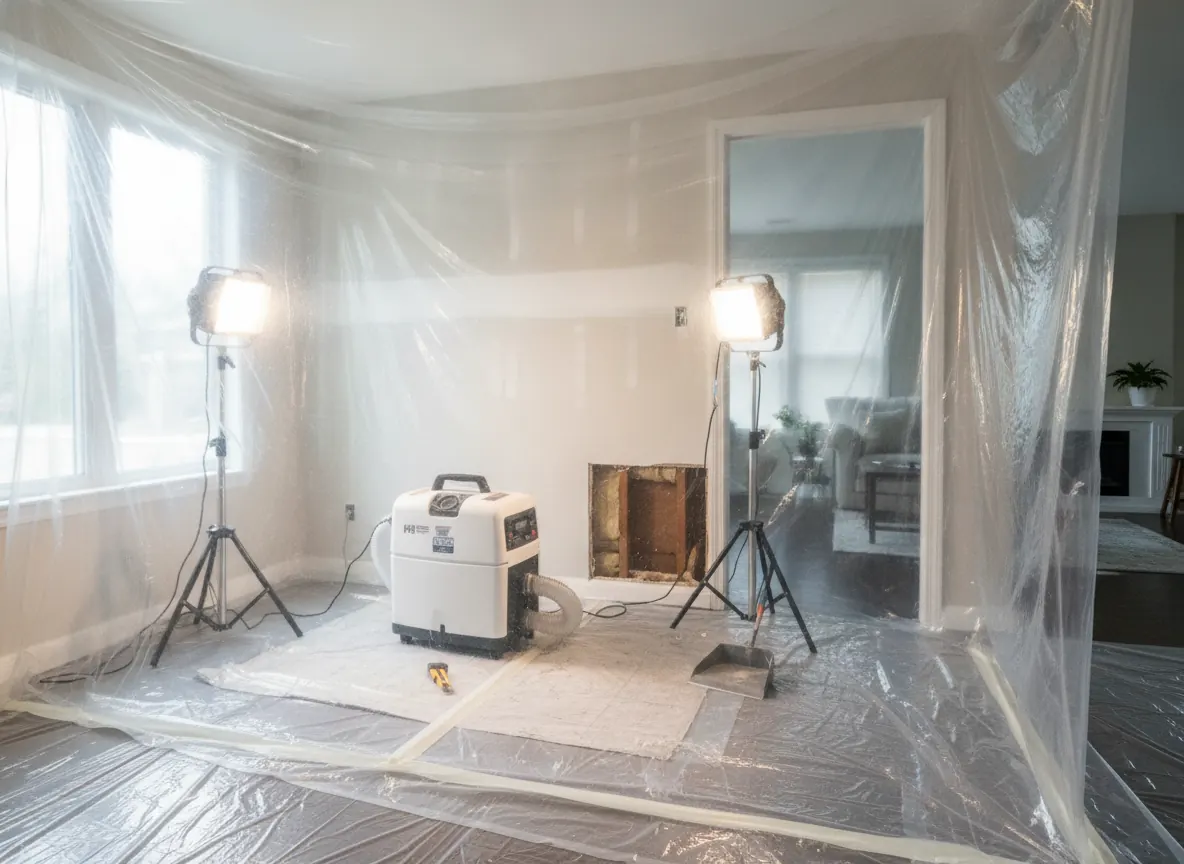
Cleaning means wiping or scrubbing mold off a surface. Remediation is a controlled process for removing mold and the materials it has damaged, without spreading it to the rest of the house. A typical job includes:
- Finding and fixing the moisture source.
- Containing the work area, often with plastic sheeting and negative air pressure.
- Removing porous materials that cannot be cleaned, such as wet drywall, insulation and carpet pad.
- Cleaning framing and hard surfaces, and HEPA vacuuming.
- Drying the area and confirming moisture levels.
- Optional independent clearance testing at the end.
Our process page walks through the steps from first quote to clearance, and the mold removal page covers what companies in San Diego County typically include.
What California law says (and does not say)
California's Toxic Mold Protection Act of 2001 asked the state health department to set mold exposure limits. The department concluded in 2005 that science-based limits for indoor molds could not be established at that time. The Act's landlord and seller disclosure duties depend on standards that were never adopted. So there is no California threshold that makes remediation legally required, and no safe or unsafe mold level set by the state.
A few rules still matter:
- Rentals. Visible mold can make a rental substandard once a health officer or code enforcement officer finds it, excluding minor mold on surfaces that get wet in normal use (Health and Safety Code 17920.3(a)(13)). The landlord's duty to repair starts once the landlord has notice (Civil Code 1941.7).
- Licensing. California does not license mold inspection or remediation as its own trade, so checking credentials is up to you. But any job of $1,000 or more, any job that needs a permit, and any job with a crew requires a CSLB contractor license.
- Asbestos. In buildings with five or more units, San Diego County APCD Rule 1206 requires an asbestos survey and 10 working days' notice before renovation that disturbs 100 square feet or more of material. Single-family homes are outside that rule, though Cal/OSHA worker rules still apply to contractors.
- Permits. In the City of San Diego, small like-for-like repairs of $1,000 or less with no electrical, plumbing or mechanical work need no building permit, and up to 100 square feet of drywall replaced as part of such a trade repair is exempt (DSD Information Bulletin 203, July 2024). Larger rebuilds usually need a No-Plan permit.
None of this is legal advice. For a dispute, talk to a California attorney or a tenant-rights resource.
When cleaning is usually enough
EPA's homeowner guidance is commonly summarized as treating mold patches smaller than about 10 square feet, roughly 3 feet by 3 feet, as a job most people can handle themselves. Check EPA's current mold pages before relying on that figure. Size is only part of it. Cleaning is usually enough when:
- The area is small and on the surface.
- The material is hard and non-porous: tile, glass, metal, sealed wood, a painted window frame.
- The water source is known and fixed.
- Nothing behind the surface is wet or soft.
- Nobody in the home has health concerns that make the work a bad idea.
Examples: pink or black film on shower grout (see pink mold in the shower), spots on a window sill from condensation, a few spots on a cabinet floor after a small drip.
When remediation is usually the better call
| Situation | Why it points to remediation |
|---|---|
| Mold covers more than about 10 sq ft | More material to remove and more risk of spreading it during cleanup. |
| Mold on drywall, insulation or carpet pad | Porous materials usually need removal, not cleaning. |
| Mold inside walls, ceilings or ducts | Opening the cavity or cleaning ducts needs containment and the right equipment. |
| Flood water, sewage or a long-running leak | More material is wet, and contaminated water raises cleanup standards. |
| Musty smell with no visible source | Suggests hidden growth that needs to be found first. |
| You need a record for a landlord, buyer or insurer | A written scope and independent clearance report document the work. |
| Older home with materials that may contain asbestos | Testing before tear-out is best practice. |
EPA advises drying water-damaged areas and items within 24–48 hours to prevent mold growth. After a bigger water event, such as the January 22, 2024 flood that hit Southcrest, Shelltown and other areas, materials that stayed wet longer are the ones most likely to need removal. The water damage and mold page covers that situation.
Do you need a test to decide?
Usually not. CDC does not recommend mold testing, and says that no matter what type of mold is present, you need to remove it. With no state exposure limits, a lab number does not tell you whether remediation is legally required. Testing is useful for finding hidden growth when there is a smell but no visible mold, and for clearance after the work. See the inspection and testing page.
What remediation costs
Published national estimates run about $1,500–$9,000 for a typical job, average about $3,500 (Fixr, Aug 2025), and $1,200–$3,750, average about $2,300 (This Old House, Mar 2026). Per square foot, $10–$30 (Fixr) and $10–$25 (This Old House). Those are not quotes. See the San Diego mold remediation cost guide and calculator.
How to vet a company
Ask for the following before you sign:
- A CSLB license number for any job of $1,000 or more, any job that needs a permit, or any job with a crew. Look it up at cslb.ca.gov.
- IICRC or ACAC certification for the people doing the work, which you can check on iicrc.org and acac.org.
- A current insurance certificate.
- A written scope and protocol: what gets removed, cleaned and dried, and how the work area is contained.
- A plan for the moisture source, whether the company fixes it or a plumber or roofer does.
- Independent clearance testing after the work, from someone other than the remediation company, if you want proof it is done.
- A written contract for any home improvement job over $500 (Business and Professions Code 7159).
For in-home sales, Civil Code 1689.6 gives you three business days to cancel (five for seniors), and seven business days for repair contracts after a declared disaster.
Frequently asked questions
Is mold remediation required by law in California?
There is no general state rule that sets a mold level or size that requires remediation. California's health department concluded in 2005 that science-based exposure limits could not be set. Rental habitability rules and contractor licensing still apply.
How much mold can I clean myself?
EPA guidance is commonly summarized as treating patches under about 10 square feet as a homeowner job, if the water problem is fixed and the mold is on hard surfaces. Check EPA's current pages, and get quotes for larger areas or wet porous materials.
Does a landlord have to remediate mold in California?
Visible mold can make a rental substandard once a health or code enforcement officer finds it, and the landlord's duty to repair starts on notice under Civil Code 1941.7. Report it in writing. This is not legal advice.
Do I need a mold test before remediation?
Usually not. CDC does not recommend mold testing and says mold should be removed whatever the type. Testing helps find hidden growth and confirm clearance after the work.
San Diego Mold Experts is a free quote service, not a mold company. You describe the problem once, and independent mold inspection and remediation companies serving San Diego, CA and nearby San Diego County towns may reply with quotes. Companies may pay to receive requests or calls, and they reply on their own schedules. Request free quotes or call (619) 489-9035.